Retro St.Patrick’s Day SVG PNG Design Review
As a designer who spends half my life staring at digitized files and the other half troubleshooting stitch errors, I don’t just buy graphics—I evaluate them. When I first pulled up Retro St.Patrick’s Day SVG PNG Design, my immediate reaction wasn’t about the holiday itself, but about how this specific aesthetic translates from a flat vector into three-dimensional thread. We are in an era where the market is saturated with generic shamrocks and overly complex Celtic knots that look muddy when stitched at small scales. This design offers a different path: a cleaner, bolder retro vibe that feels intentional rather than accidental.
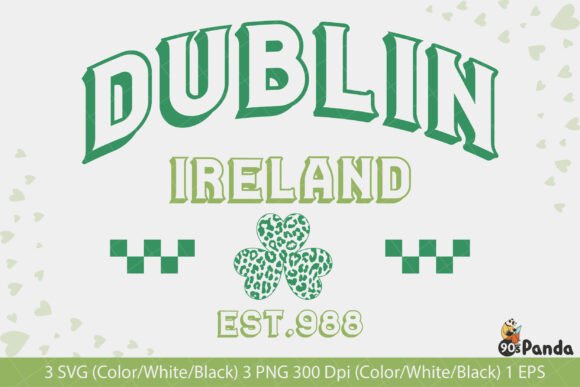
The file package includes seven distinct formats—three SVGs, three high-resolution PNGs at 300 dpi with transparent backgrounds, and one EPS file. For an embroidery professional, the SVGs are the primary workhorses. They allow for clean scaling without pixelation, which is crucial when you are preparing a custom apparel project or resizing a graphic for a smaller hoop size on a cap. The inclusion of black and white versions for both formats is a smart move, allowing me to test contrast ratios before committing to expensive specialty threads.
Visual Personality and First Impressions
The "retro" descriptor here does heavy lifting. It suggests a mid-century modern influence or perhaps a vintage collegiate style—bold lines, simplified shapes, and a lack of clutter. In the world of machine embroidery, less is often more. Complex gradients and tiny details that look beautiful on screen frequently turn into a tangled mess of stitch density issues when executed on fabric. This design seems to respect the limitations of the needle.
Visually, it creates a mood that is nostalgic yet fresh. It doesn’t scream for attention like neon green; instead, it whispers with confidence. This makes it incredibly versatile for a boutique brand. Whether you are creating items for a local craft fair or listing digital assets on Etsy, the aesthetic feels premium. It avoids the tacky pitfalls associated with some holiday-specific graphics, making it suitable for customers who want to celebrate the day without looking like they raided a discount bin.
Real-World Application: The Tote Bag Scenario
To truly judge an embroidery project, you have to imagine it on a finished product. Let’s take a hypothetical scenario: I am designing a limited run of canvas tote bags for a spring market. I need something that pops against natural beige or deep navy fabric but isn’t so intricate that it requires hours of stitching time.
I place the Retro St.Patrick’s Day SVG PNG Design centered on the bag. Because the design likely relies on strong outlines and solid fills, it holds its shape well even on a textured canvas. If I were to use the SVG to create a custom patch to sew onto the corner, the clean edges would minimize fraying and make the applique process smoother. The transparency in the PNG files allows me to mock up the design on various background colors digitally before I even cut the stabilizer. This saves time and reduces waste—a critical factor for any serious craft business.
Furthermore, this design works beautifully for personalized gifts. Imagine a baby onesie or a nursery wall hanging. The retro style ages well, meaning a gift bought today will still feel stylish years later. It bridges the gap between a seasonal novelty and a timeless piece of decor, which increases its perceived value for the end consumer.
Performance in Stitching and Fabric Interaction
When evaluating an embroidery file, we must consider how it interacts with different materials. This design appears to be best suited for stable fabrics. While it might look good on a sturdy sweatshirt or a denim jacket, applying it to thin, stretchy jersey knits requires caution. Without proper stabilization, the tension could pucker the fabric, ruining the crisp lines that define the retro aesthetic.
The black and white variants provided are essential for testing thread color contrast. On dark fabrics, a light-colored outline will define the shape, while on light fabrics, a dark fill provides the necessary pop. I recommend running a test stitch on scrap fabric first. Pay close attention to the corners and any curved elements. If the design features sharp angles, ensure your digitizing software handles the corner stitches correctly to avoid bird nesting. If it uses a satin stitch for borders, check that the stitch length is appropriate for the curve radius.
For those considering this for an embroidered patch, the simplicity is a blessing. Patches often undergo significant wear and tear. A design with fewer fine details is less prone to snagging or unraveling over time. This durability makes it a strong candidate for commercial merchandise, such as branded caps or aprons for a coffee shop.
Where to Use With Caution
While this design is robust, it is not a universal fit. Avoid using it on highly textured fabrics like bouclé or thick terry cloth, as the needle may struggle to penetrate evenly, leading to skipped stitches. Additionally, if you plan to use this for a very small accessory, such as a keychain or a miniature ornament, you must verify the minimum safe distance between stitch elements. What looks clear on a 12×12 inch screen might become indistinguishable blobs when reduced to a two-inch hoop.
Also, consider the washing instructions for the final product. If you are selling handmade goods, always advise customers on proper care. Designs with dense fills can sometimes trap moisture if not stitched correctly, potentially affecting the longevity of the embroidery on delicate items like kitchen towels or tea towels.
Strategic Value for Sellers and Makers
For the Etsy seller or small shop product creator, versatility is currency. Having access to both vector (SVG/EPS) and raster (PNG) files means you can adapt this asset across multiple platforms. You can use the SVG for direct-to-film printing transfers if you offer mixed-media products, or use the PNG for quick social media previews. This flexibility enhances your brand consistency across all touchpoints.
The design also supports a wide range of holiday embroidery applications. It fits naturally into a collection of spring-themed items, including pillow covers, blanket borders, and wedding favors. By choosing a retro style, you differentiate yourself from competitors who are using traditional, cliché imagery. This uniqueness can drive higher engagement and conversion rates, as buyers are often drawn to designs that feel curated and thoughtful.
Practical Designer Notes
- Test First: Always stitch out a test version on the actual fabric you intend to use. Check for puckering, thread breaks, and alignment.
- Check Licensing: Before selling finished items or digital products, confirm the licensing terms. Ensure you have the right to use the design commercially.
- Stabilizer Selection: Use a cut-away stabilizer for stretchy fabrics and a tear-away for woven fabrics to maintain stability during the machine embroidery design process.
- Thread Choice: Experiment with metallic or variegated threads to add depth, but be aware that these can affect stitch quality and require slower speeds.
- Mockup Validation: Use the black and white PNGs to create grayscale mockups. This helps visualize the design’s impact regardless of the final thread colors chosen.
In conclusion, Retro St.Patrick’s Day SVG PNG Design is a solid addition to any designer’s library. It balances aesthetic appeal with practical usability, making it suitable for everything from personal gifts to high-volume commercial runs. Its clean lines and retro charm allow it to stand out in a crowded market, provided it is executed with the care and technical precision that quality embroidery demands.